Dictate the case once. Get back a report in its sections.

Updated

Verbato writes a medical report from your dictation.

For physicians who report to insurers, employers or medical boards.

Start with a recording

  • Without an account, your recording is held for 24 hours. It starts when you create your account; if you don't, it is deleted.
  • Free plan: 2 h of audio a month. Files up to 40 min.
  • YouTube, Spotify, Google Drive, Dropbox and more than 1,000 sites.
  • Your recordings are never used to train or improve models.

Your recording is saved for 24 hours. It starts when you create your account.

What is a medical report?

A medical report is the physician's account of a case for someone outside the care team, such as an insurer or an employer: the illness, the examination and studies, the diagnosis, the treatment, the functional status and the prognosis.

In practice

Its reader is outside the care team, an employer or an insurer, and in Great Britain the patient may read it first. Under the Access to Medical Reports Act 1988, a person can ask to see a report that a doctor responsible for their care prepares for employment or insurance purposes before it is supplied, and can ask for any part they consider incorrect or misleading to be amended; where the doctor declines, a statement of the patient's views can be attached. Once the patient has seen it, the report cannot be sent until they consent (UK Parliament, 1988).

Further reading: The Royal College of Radiologists' standards for reporting imaging; Weed (1968), on the problem-oriented record the SOAP note comes from

What you say, and the medical report you get back

Illustrative example

The transcript excerpt and the document are written to show the format. Every name, figure and quote is invented.

What you say · transcript excerpt

work capacity and restrictions colon modified duty for two weeks scratch that for three weeks period new line no lifting over ten pounds with the right arm period new line no work above shoulder height period new paragraph prognosis colon good comma with recovery expected in six to eight weeks period

  • appears in this excerpt
  • no mark: from a part of the recording not shown here

What comes back · medical report

Purpose and recipient

Report requested by the employer's insurer on a work-related injury, to support modified duty.

Present illness

Right shoulder pain since September 3, after lifting a box at work. No improvement with anti-inflammatories and 10 physical therapy sessions.

Examination

Painful arc between 70 and 120 degrees on the right. Strength of external rotation 4/5 on the right.

Studies

MRI of the right shoulder, September 20: partial-thickness tear of the supraspinatus tendon.

Diagnosis

Partial-thickness tear of the right supraspinatus tendon.

Treatment

Naproxen 500 mg by mouth twice daily.

Referral to orthopedics.

Functional status

Cannot lift the right arm above shoulder height or carry more than 10 lb.

Work capacity and restrictions

Modified duty for 3 weeks. (appears in this excerpt)

No lifting over 10 lb with the right arm. (appears in this excerpt)

No work above shoulder height. (appears in this excerpt)

Prognosis

Good, with recovery expected in 6 to 8 weeks. (appears in this excerpt)
History · Complications · Other relevant information — also part of a medical report; nothing in this example's recording calls for it, so it is left out.

Illustrative example

End of the illustrative example. Neither the excerpt nor the document was produced by Verbato.

What it looks like

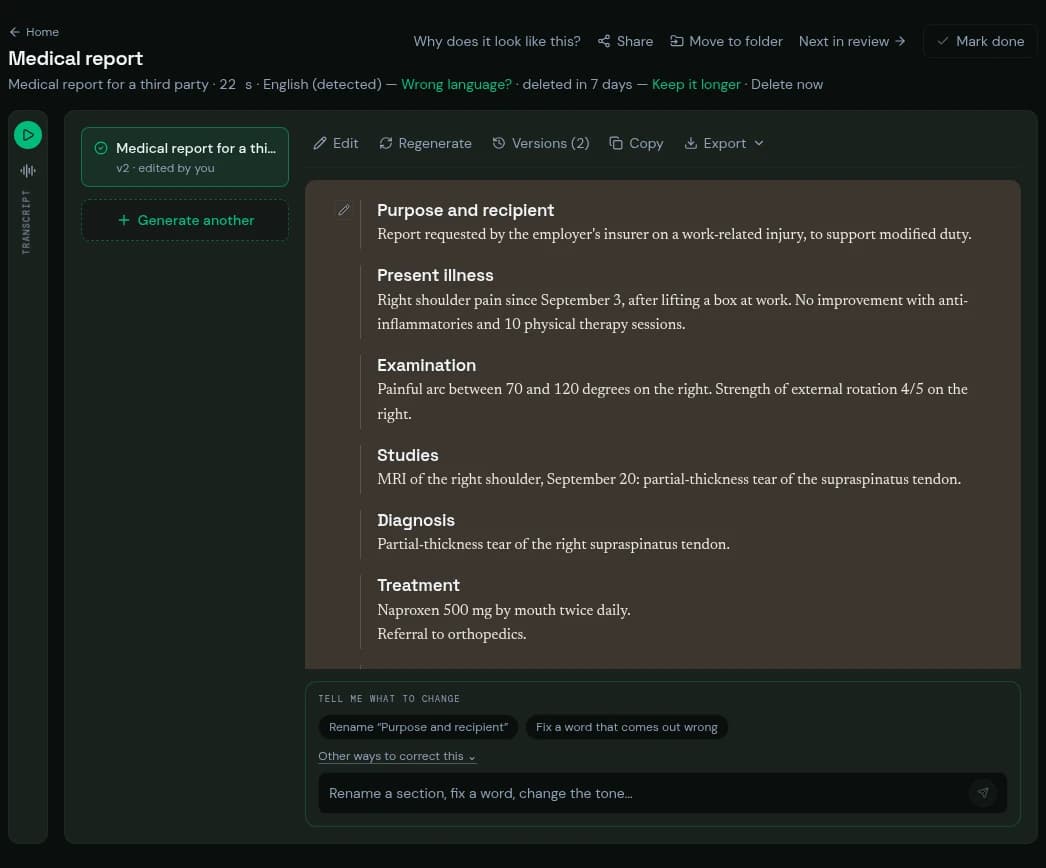
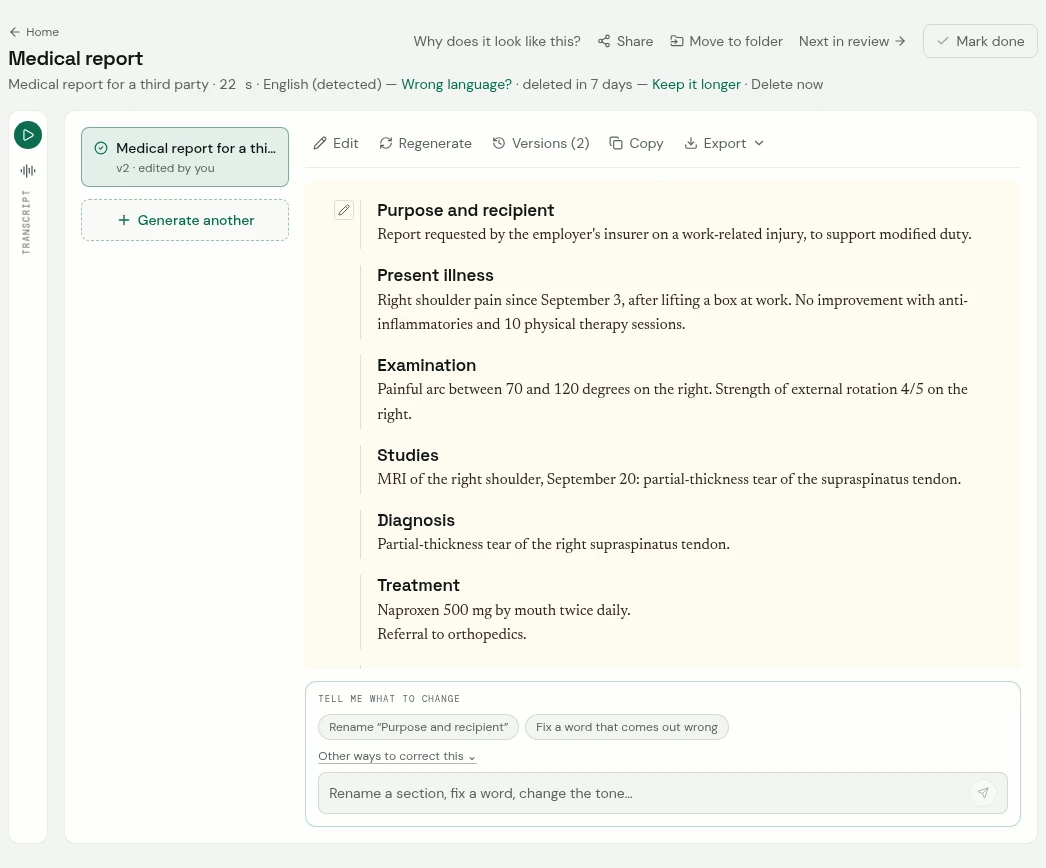
Verbato's project screen: the medical report, in its sections, with the transcript folded beside it and a box to ask for a change.
  1. The transcript, folded beside the document: one press opens it, line by line with times.
  2. The document, in its sections.
  3. A change, asked for in your own words.

Verbato's app. The content was written to show it.

A blank medical report to copy

Purpose and recipient

Who the report is for and why it was requested.

History

Past illnesses, operations, habits and allergies that bear on the report.

Present illness

The onset, how an injury happened, the course and the treatment so far.

Examination

The relevant findings, with their side.

Studies

The studies with their dates and interpretation.

Diagnosis

The diagnoses, with their side and any codes.

Treatment

The treatment given and proposed, with dates of surgery or hospital stay.

Complications

Any complications, or a statement that there were none.

Functional status

What the patient can and cannot do, and how that changes over time.

Work capacity and restrictions

Time off work, modified duty with its restrictions, or full duty.

Prognosis

The prognosis and the expected time to recovery.

Other relevant information

Anything else the recipient needs, such as an occupational origin.

How your medical report is written

  • The report opens with its purpose and recipient, never with who the patient is.

  • Diagnoses keep the laterality and the codes you dictated, never looked up.

  • A section you did not dictate is left out, never filled in.

  • The word-for-word transcript sits beside the report, so you check before you sign.

Your format, not ours

The sections of your medical report and the way it is written are yours to change. To fix a document, say what is wrong in your own words.

  1. 1You correct it

    “Call the ‘Purpose and recipient’ section ‘Reason for the report’.”

    That medical report changes. Nothing else does.

  2. 2You say it again

    Make the same correction on a later medical report and Verbato asks: “You've changed this before. Always?”

  3. 3You decide

    Answer “Always” and it is kept as a rule, applied from your next medical report on. Answer “Just this once” and nothing is kept. Documents already written stay as they are, and nothing becomes a rule unless you confirm it.

  4. 4Your rules

    I call the “Purpose and recipient” section “Reason for the report”.Undo

    Every rule you have kept is listed, and you can undo any of them. An undone rule stops applying from your next medical report.

How it works

Upload a file, paste a link, record in your browser, or send a voice note by Telegram or email. Verbato makes a word-for-word transcript, which you can edit and which stays beside the document. Your medical report is written from it, in minutes.

Recording limits

A recording made in your browser can run up to 30 min on every plan; a longer session goes in as a file you upload. A free account takes recordings of up to 40 min each; for longer ones, see pricing.

Your recording

Deleted after 7 days by default, together with its transcript and documents. You can keep a project longer, up to your plan's limit. Deleting a recording leaves a receipt you can download. Nothing you record is used to train or improve AI models. Recording patients or clients? Read what Verbato does with sensitive recordings.

Questions about the medical report

Who is a medical report for?
For someone outside the care team who needs your account of the case: an insurer, an employer, a disability or workers' compensation process, a medical board. The report states its purpose and recipient first, then the case.
Does the report include the patient's name or policy number?
No. The report leaves out the patient's name, policy and ID numbers even when you dictate them; you add them in the recipient's form. The transcript keeps everything you said.
Can Verbato fill in the insurer's or employer's form?
No. Verbato writes the report's sections; copy each one into the form, or attach the report as a Word document or a PDF. It has no built-in connection to an insurer's or employer's system.
What if I correct a date or a restriction in the middle of a sentence?
When you dictate to Verbato, say “scratch that” or “correction” and carry on. The report takes the corrected wording and leaves out the slip. The transcript still shows everything you said.

Dictate your next report. Check it. Sign it.

Start freeFree sign-up