Your interviews come back as themes — with the quotes to prove them.

Verbato writes research documents from your recorded sessions: interview summaries, quote banks, usability findings reports and focus group toplines.

For academic, UX and market researchers who run interviews, usability sessions and focus groups.

Start freeFree sign-up

What does Verbato write for researchers?

Verbato writes the documents of qualitative research from your recorded sessions: the interview summary and the quote bank from an interview, the usability findings report from a usability session, and the focus group topline from a focus group.

Send the recording the way you have it: upload a file, paste a link, record in your browser, or send a voice note by Telegram or a recording by email.

The document comes back in its sections and in the language of the recording, with the word-for-word transcript beside it. Where a section was written from a moment of the recording, a mark plays that moment, so you can check each theme and each quote before you use it: a document can contain errors, and checking it is your job. If your team sets out a document differently, change its sections, and Verbato keeps your version as a document of your own. You pay for hours of audio; documents and corrections are not counted. The plans are on the pricing page.

What it looks like

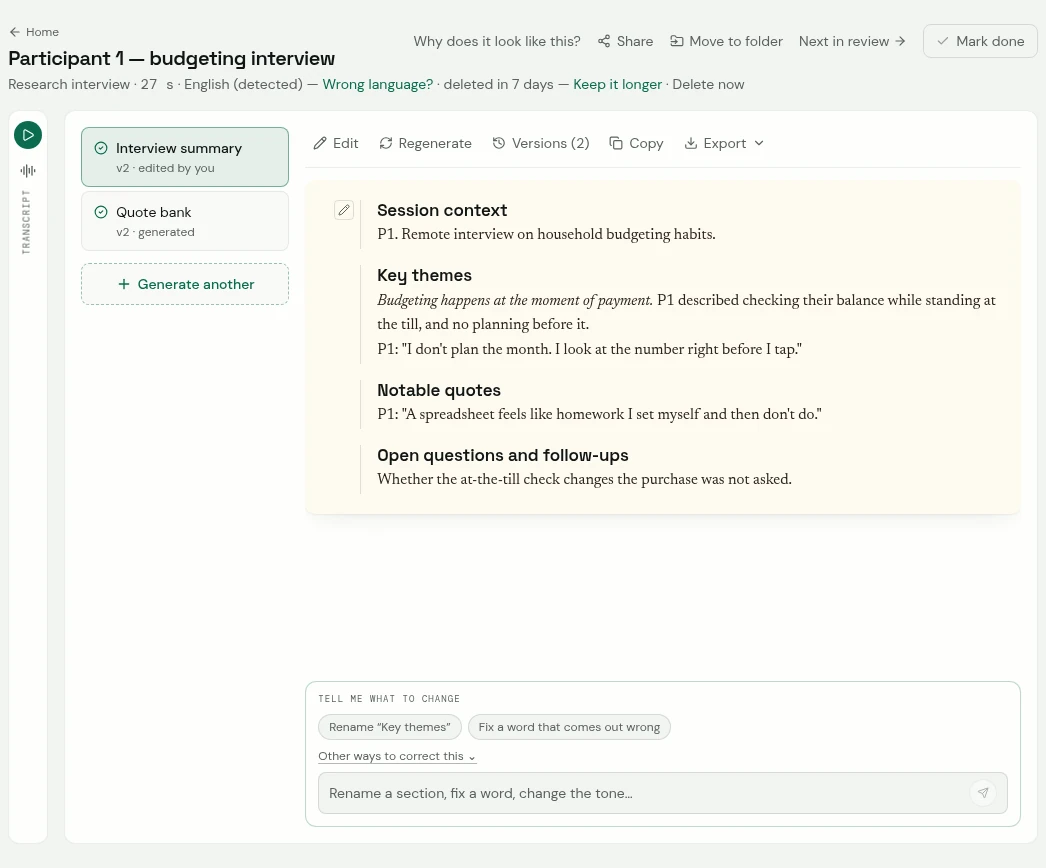
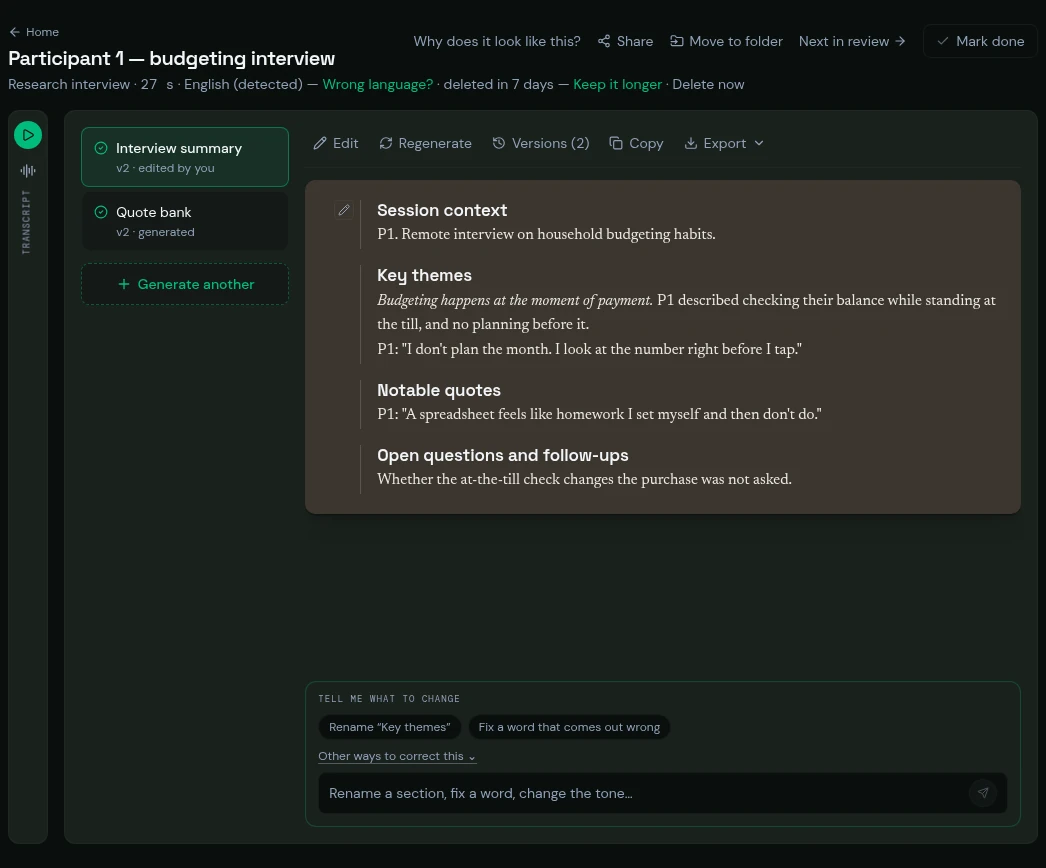
Verbato's project screen for a recorded research interview: the interview summary in its sections, the quote bank beside it, and the transcript folded into a rail.
  1. The transcript, folded beside the document: one press opens it, line by line with times.
  2. The document, in its sections.
  3. A change, asked for in your own words.

Verbato's app. The content was written to show it.

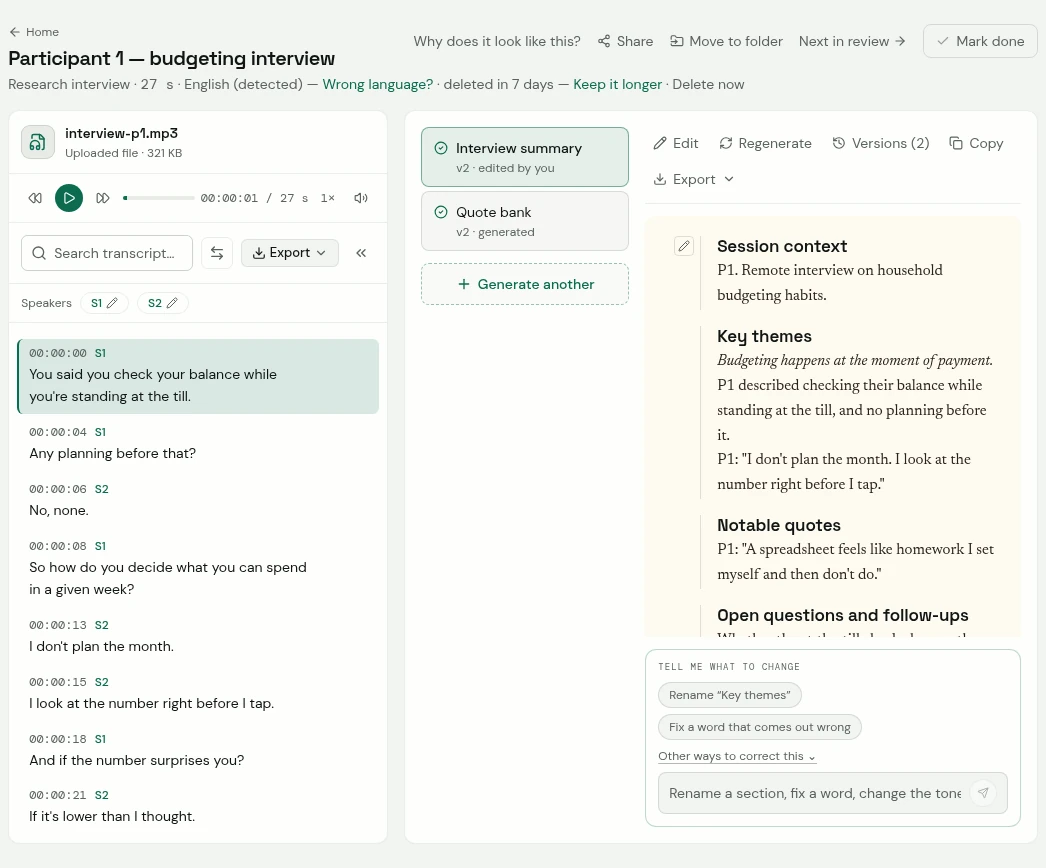
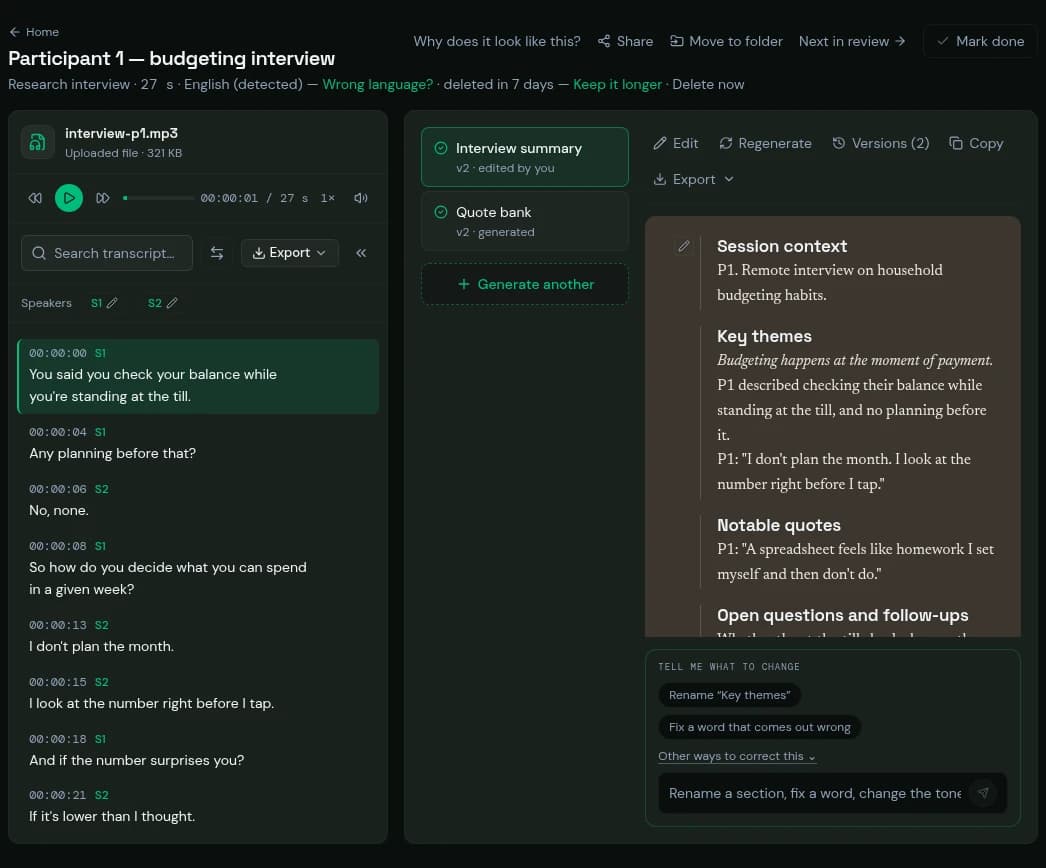
The same screen after the mark beside a section was pressed: the interview's transcript is open at the line that section was written from, each line with its speaker.
  1. The mark beside a section.
  2. The line it was written from, played from its moment.

Verbato's app. The content was written to show it.

An interview summary and its quote bank, both written from one recorded interview.

Illustrative example

Both documents are written to show the format. Every name, figure and quote is invented.

Session context

P1. Remote interview on household budgeting habits.

Key themes

Budgeting happens at the moment of payment. P1 described checking their balance while standing at the till, and no planning before it.

P1: "I don't plan the month. I look at the number right before I tap."

Notable quotes

P1: "A spreadsheet feels like homework I set myself and then don't do."

Open questions and follow-ups

Whether the at-the-till check changes the purchase was not asked.

Quotes by theme

Checking the balance

P1 [06:14]

"I don't plan the month. I look at the number right before I tap."

P1 [07:02]

"If it's lower than I thought [...] I put something back."

Tools tried

P1 [18:40]

"A spreadsheet feels like homework I set myself and then don't do."

Illustrative example

End of the illustrative example. Neither document was produced by Verbato.

Your format, not ours

The sections of each document and the way it is written are yours to change. To fix a document, say what is wrong in your own words. Make the same correction a second time and Verbato asks whether to keep it. Nothing becomes a rule unless you confirm it, and you can undo any rule.

How it works

Upload a file, paste a link, record in your browser, or send a voice note by Telegram or email. Verbato makes a word-for-word transcript, which you can edit and which stays beside your documents. They are written from it, in minutes.

Recording limits

A recording made in your browser can run up to 30 min on every plan; a longer session goes in as a file you upload. A free account takes recordings of up to 40 min each; for longer ones, see pricing.

Your recording

Deleted after 7 days by default, together with its transcript and documents. You can keep a project longer, up to your plan's limit. Deleting a recording leaves a receipt you can download. Nothing you record is used to train or improve AI models. Recording patients or clients? Read what Verbato does with sensitive recordings.

Questions before you start

Are participants' names taken out?
No: in Verbato, the transcript keeps whatever was said, names included. The research documents refer to each participant by a code, such as P1.
Do I get the summary and the quotes from the same interview?
Yes, file the recording as a research interview and Verbato returns both: the interview summary and the quote bank, each written from the same transcript.
Can I trace a quote back to the moment it was said?
Yes, in Verbato each quote carries its time and the participant's code, and the time is a link: it opens the transcript at that moment.
Do I pay per interview or per participant?
Neither: with Verbato, you pay for hours of audio. Documents, corrections and exports are not counted, and signing up is free. The plans are on the pricing page.
Where are my recordings kept, and who can read them?
Verbato processes and stores your recordings in the United States and Canada. Nobody at Verbato listens to them or reads them, unless you ask us to in order to resolve a support issue, or we are required to.

Record the next interview. Check each theme against the transcript.

Start freeFree sign-up