Dictate the admission once. Get the H&P back in order.

Updated

Verbato writes a history and physical from your dictation.

For physicians who admit patients or see them first.

Start with a recording

  • Without an account, your recording is held for 24 hours. It starts when you create your account; if you don't, it is deleted.
  • Free plan: 2 h of audio a month. Files up to 40 min.
  • YouTube, Spotify, Google Drive, Dropbox and more than 1,000 sites.
  • Your recordings are never used to train or improve models.

Your recording is saved for 24 hours. It starts when you create your account.

What is a history and physical?

A history and physical, or H&P, is the physician's complete record at admission or at a first visit: the present illness, the past, family and social history, the examination, the results, the assessment and the plan.

In practice

In US hospitals, Medicare's conditions of participation set its timing. A medical history and physical examination must be completed and documented no more than 30 days before or 24 hours after admission or registration, and in any case before surgery or a procedure requiring anesthesia. When it was done in the 30 days before, an updated examination recording any changes in the patient's condition must be documented within 24 hours after admission, again before surgery. It is done by a physician, an oral and maxillofacial surgeon or another qualified licensed individual, as state law and hospital policy allow (CMS, 2019).

Further reading: The Royal College of Radiologists' standards for reporting imaging; Weed (1968), on the problem-oriented record the SOAP note comes from

What you say, and the history and physical you get back

Illustrative example

The transcript excerpt and the document are written to show the format. Every name, figure and quote is invented.

What you say · transcript excerpt

social history colon smokes one pack per day for thirty years period drinks alcohol socially period new paragraph vital signs colon blood pressure one fifty two over ninety four comma heart rate ninety six scratch that heart rate eighty six comma oxygen saturation ninety seven percent on room air period

  • appears in this excerpt
  • no mark: from a part of the recording not shown here

What comes back · history and physical

Chief complaint

Chest pain for 2 days.

History of present illness

Substernal pressure on exertion, relieved by rest, worse since yesterday. No syncope.

Past medical history

Hypertension. Hyperlipidemia. Appendectomy at age 20.

Medications

Lisinopril 20 mg by mouth daily.

Atorvastatin 40 mg by mouth at night.

Allergies

No known drug allergies.

Social history

Smokes 1 pack per day for 30 years. Drinks alcohol socially. (appears in this excerpt)

Vital signs

Blood pressure 152/94, heart rate 86, oxygen saturation 97% on room air. (appears in this excerpt)

Physical examination

Alert and oriented. Lungs clear to auscultation bilaterally. Heart with regular rhythm, no murmurs. No leg edema.

Results

Troponin 0.04 ng/mL. ECG with 1 mm ST depression in V5 and V6.

Assessment

Unstable angina; rule out non-ST-elevation myocardial infarction.

Plan

Admit to telemetry.

Aspirin 325 mg by mouth once.

Heparin infusion per protocol.

Repeat troponin in 6 hours.

Cardiology consult.
Family history · Review of systems · Prognosis — also part of a history and physical; nothing in this example's recording calls for it, so it is left out.

Illustrative example

End of the illustrative example. Neither the excerpt nor the document was produced by Verbato.

What it looks like

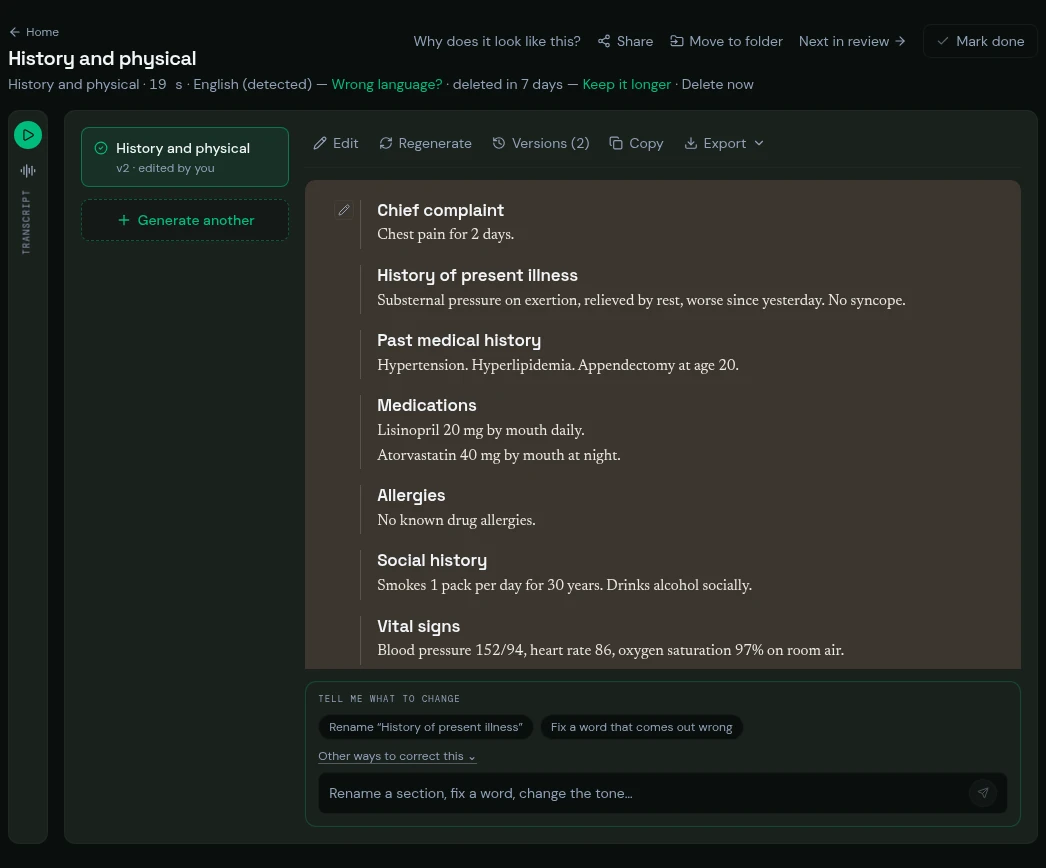
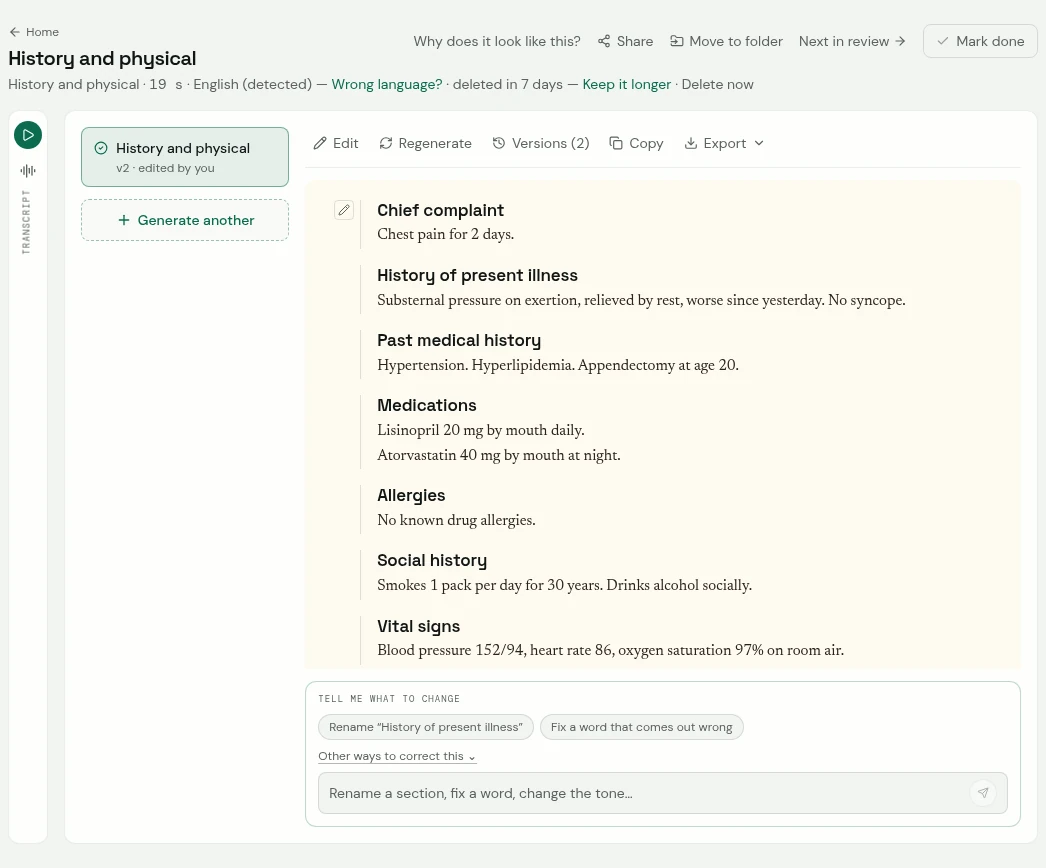
Verbato's project screen: the history and physical, in its sections, with the transcript folded beside it and a box to ask for a change.
  1. The transcript, folded beside the document: one press opens it, line by line with times.
  2. The document, in its sections.
  3. A change, asked for in your own words.

Verbato's app. The content was written to show it.

A blank history and physical to copy

Chief complaint

The reason for the visit or admission, in a few words.

History of present illness

The current illness in order, as the patient reported it.

Past medical history

Chronic diseases, operations and hospitalizations.

Medications

The current medications with their doses.

Allergies

The allergies, or a statement that none are known.

Family history

Diseases in relatives, each by relationship.

Social history

Tobacco, alcohol, substances, occupation and living situation.

Review of systems

The symptoms asked about, system by system.

Vital signs

The vital signs, weight and height.

Physical examination

The examination, region by region.

Results

Laboratory, imaging and other results.

Assessment

The diagnoses or problems, with their certainty.

Plan

Studies, treatments and orders, one per line.

Prognosis

The physician's prognosis.

How your history and physical is written

  • A section you did not dictate is left out, never written as normal.

  • Medications keep the dose and frequency you dictated.

  • Vital signs, doses and results are written as digits, as you dictated them.

  • The word-for-word transcript sits beside the note, so you check before you sign.

Your format, not ours

The sections of your history and physical and the way it is written are yours to change. To fix a document, say what is wrong in your own words.

  1. 1You correct it

    “Call the ‘History of present illness’ section ‘Present illness’.”

    That history and physical changes. Nothing else does.

  2. 2You say it again

    Make the same correction on a later history and physical and Verbato asks: “You've changed this before. Always?”

  3. 3You decide

    Answer “Always” and it is kept as a rule, applied from your next history and physical on. Answer “Just this once” and nothing is kept. Documents already written stay as they are, and nothing becomes a rule unless you confirm it.

  4. 4Your rules

    I call the “History of present illness” section “Present illness”.Undo

    Every rule you have kept is listed, and you can undo any of them. An undone rule stops applying from your next history and physical.

How it works

Upload a file, paste a link, record in your browser, or send a voice note by Telegram or email. Verbato makes a word-for-word transcript, which you can edit and which stays beside the document. Your history and physical is written from it, in minutes.

Recording limits

A recording made in your browser can run up to 30 min on every plan; a longer session goes in as a file you upload. A free account takes recordings of up to 40 min each; for longer ones, see pricing.

Your recording

Deleted after 7 days by default, together with its transcript and documents. You can keep a project longer, up to your plan's limit. Deleting a recording leaves a receipt you can download. Nothing you record is used to train or improve AI models. Recording patients or clients? Read what Verbato does with sensitive recordings.

Questions about the history and physical

Is a history and physical the same as an admission note?
Hospitals use both names for the note written at admission. The history and physical is the complete form: the present illness, the past, family and social history, the review of systems, the full examination, and the assessment and plan.
What if I don't dictate a review of systems?
The history and physical leaves the section out. It does not write a review of systems as normal on its own: only what you dictate is written.
Can I dictate the sections in a different order?
Yes. Say a section's name and carry on: what follows goes into that section, whatever order you dictate in. The note comes back in the usual order of a history and physical.
What if I correct a value in the middle of a sentence?
When you dictate to Verbato, say “scratch that” or “correction” and carry on. The note takes the corrected value and leaves out the slip. The transcript still shows everything you said.
How do I get the note into the hospital's record?
Copy the history and physical, or export it as a Word document, a PDF or plain text, and paste it where you sign. Verbato has no built-in connection to your hospital's record system.

Dictate your next admission. Check the note. Sign it.

Start freeFree sign-up