Months after a client meeting, when someone asks what the client told you, what you advised and what the client decided, the version that counts is the one written down at the time. Lawyers call that record an attendance note in England and Wales, a file note in Australia and many UK firms, and a memo to file in the United States. This guide covers how to write one, and the other documents a meeting produces: the letter that confirms your advice, the formal letter you dictate, and the summary of a witness’s testimony. It is a practice guide, not legal advice: your regulator’s rules and your firm’s policies come first.
Why the note matters
A file note is evidence. When advice or instructions are disputed later, the note made at the time usually decides whose memory is believed. The Queensland Law Society’s guidance statement on file notes calls them “a fundamental part of ethical and competent legal practice”, and notes that professional indemnity insurers often rely on them when assessing a claim against a solicitor. In the United States, the Oregon State Bar’s Professional Liability Fund makes the same point: “Many malpractice claims arise from a client’s or third party’s allegation about what occurred, or didn’t occur, during the representation” (Edwards, 2022).
In England and Wales, paragraph 7.2 of the SRA Code of Conduct for Solicitors requires you to be able to justify your decisions and actions, and a note made at the time is the plainest way to show what you advised and why. The client interview and the attendance note that follows it are assessed in SQE2, the second part of the Solicitors Qualifying Examination, and Bowden, Brown and Sabuj (2025) give them a whole book.
When to write it
Write it during the meeting or straight after, and finish it the same day. Recap aloud at the end what was agreed: the client will remember the recap, and the note should capture it first. The Queensland guidance says file notes “have the greatest evidentiary value when made contemporaneously (or as close to the subject event as possible).” Two rules follow:
- Never write a note later and present it as contemporaneous. The guidance calls that dishonest and likely professional misconduct. If you missed a note, write one now, dated now.
- Say when a note was rewritten. If you type a fuller note from rough notes, keep the rough notes with it. A note that was recopied or edited must be disclosed as such when it is produced in evidence, even for changes as small as formatting or grammar.
What a file note records
- The matter: the client, the file reference and the purpose of the meeting.
- When and how: the date, the start and end times, and whether it was in person, by phone or by video. For a call, who called whom and what was shared on screen.
- Who was there. If a relative or a business partner joined, say who said what. The Oregon fund advises meeting the client alone where you can, and recording who was present either way.
- What the client told you: the facts, dates and people, and the documents they gave or mentioned.
- The advice you gave: the options, the risks of each, your recommendation, and what you said about costs.
- The client’s instructions: what they decided, what they asked you to do, and any advice they chose not to follow.
- Next steps: who does what by when, and what is still missing.
- Time recorded, so that the bill and the file agree.
Keep the client’s account apart from your advice
- Label each part. “The client says she signed on 3 March” and “Advised a letter before claim” are different kinds of sentence, and headings for facts, advice and instructions keep them apart.
- Record a belief as a belief. “The client believes the buyer is withholding payment” is not “The buyer is withholding payment.”
- Do not fill gaps. If the client could not remember a date, the note says so. A detail inferred in a note is read later as a detail the client gave.
Record impressions of the client only where they may matter later, as when capacity could be questioned; the Queensland guidance reminds you that the client, the regulator or a court may one day read the note.
An example
Illustrative example. Written to show the format. Every name, figure and quote is invented, and the note was not produced by Verbato.
- Matter: Ms Elena Ruiz, unpaid invoice no. 0412 owed by Harlow Fittings Ltd (“the Debtor”).
- Attendance: 14 May, 10:00 to 10:35, in person. Present: Ms Ruiz; David Okoye, solicitor.
- Client’s account: she invoiced £18,640.00 on 5 February; £13,640.00 is unpaid. She believes the Debtor is withholding it over a defect it has not put in writing. She does not recall when she last spoke to the Debtor.
- Advice: a letter before claim before any proceedings; risk of a counterclaim over the alleged defect explained. Fee for the letter given.
- Instructions: send the letter this week.
- Next steps: Ms Ruiz to send the delivery note and the invoice by 16 May; DO to draft the letter on receipt.
- Time: 35 minutes attending; 10 minutes on this note.
Recording the meeting, or dictating afterwards
- Recording gives you the full record, and lets you listen instead of writing. Ask the client’s consent before you start, and say who will hear it and how long it will be kept. Recording law differs between jurisdictions, and in some places recording without notice or consent is unlawful.
- Dictating afterwards records no one but you, and makes you put the meeting in order while it is fresh.
A recording of a client meeting can hold privileged material. Before it goes into any transcription or AI service, check how that service handles data and who can reach it. The Queensland guidance asks for the same check.
The client follow-up letter
The note is for the file; the letter is for the client. It confirms what was said, so that both of you work from one version; it is not the client care letter (UK) or engagement letter (US) that sets your terms. ABA Model Rule 1.4, which most states’ rules follow, requires a lawyer to “explain a matter to the extent reasonably necessary to permit the client to make informed decisions regarding the representation”. Paragraph 8.6 of the SRA Code asks you to give clients information in a way they can understand. A letter that confirms your advice is the record that you did. It covers:
- The facts as you understood them, so the client can correct what you got wrong.
- Your advice as you gave it, with the options and their risks. The letter confirms advice; it adds none.
- What you need from the client, and by when.
- The next steps and deadlines for each of you, and any advice the client chose not to take.
Send it within a few days, and the same day when a deadline is close. Write for someone who is not a lawyer: no Latin, the unavoidable terms explained, the client addressed as “you”.
Dictating a formal letter
- Start with the fixed details: the recipient, the reference and the date.
- Say the punctuation: “full stop” or “period”, “comma”, “new paragraph”.
- Keep instructions apart from the text. “In capitals” and “scratch that” are for whoever types the letter. Announce them: “instruction: underline the last sentence”.
- Spell surnames, company names and references, and say figures and dates in full.
- Dictate the close: in the UK, “Yours faithfully” to an unnamed recipient and “Yours sincerely” to a named one; in the US, “Sincerely”.
In England and Wales, where no specific pre-action protocol applies, the Practice Direction on Pre-Action Conduct and Protocols expects the claimant to write first, in what practitioners call a letter before claim, with the basis of the claim, a summary of the facts, what the claimant wants and, if money, how the amount is calculated (paragraph 6(a)). It also warns that knowingly making a false statement in a pre-action letter may lead to proceedings for contempt of court, so every fact should be one the file supports. In the United States there is no single equivalent; what a demand letter must contain depends on the statute, contract or court rules that govern the claim.
Summarizing testimony
A working summary of a recorded deposition or witness interview saves listening to hours of audio again. In US practice it is a deposition summary; in England and Wales, more often the summary of a witness interview, which is not a witness statement. A good summary:
- Identifies the testimony: who spoke, when, in what matter, and who asked the questions.
- Is organized by topic, with the key statements quoted word for word, each with its time in the recording or its page and line.
- Flags inconsistencies with other testimony or documents, and what the witness admitted.
- Draws no conclusions, and says it is a working summary, not the official record.
For long testimony, open with an index of topics and the time each one starts.
Documenting your meetings with Verbato
Verbato writes a lawyer’s working documents from a recorded meeting or your dictation: the file note, the client follow-up letter, the formal letter and the testimony summary. It does not draft contracts or court documents, and it adds no legal analysis and gives no advice.
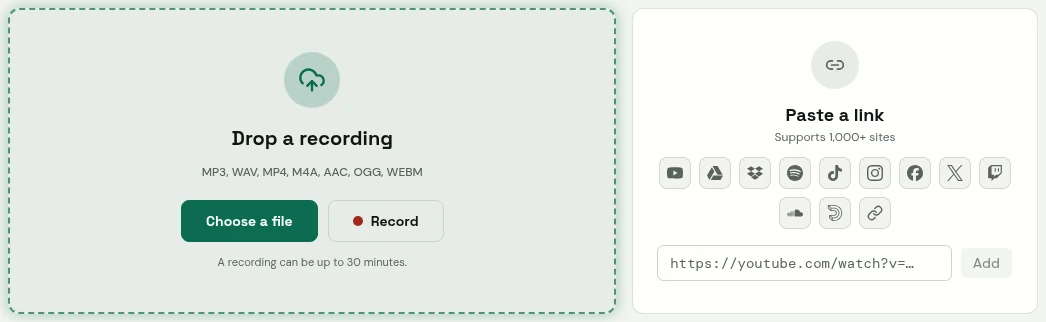
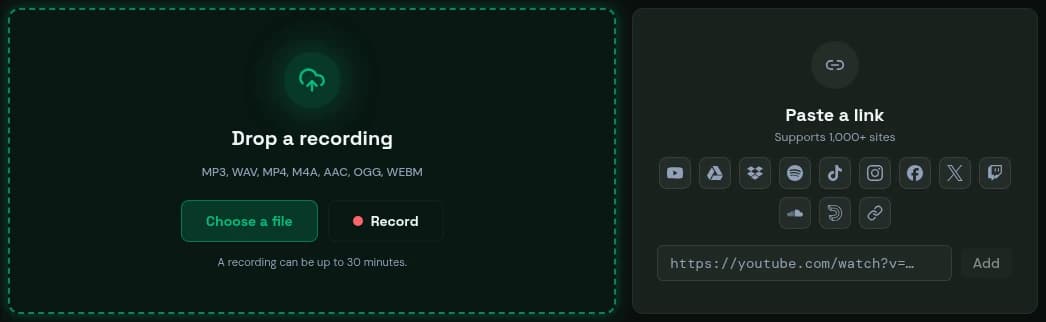
- Drop a file, or record in your browser.
- Or paste a link.
Verbato's app. The content was written to show it.
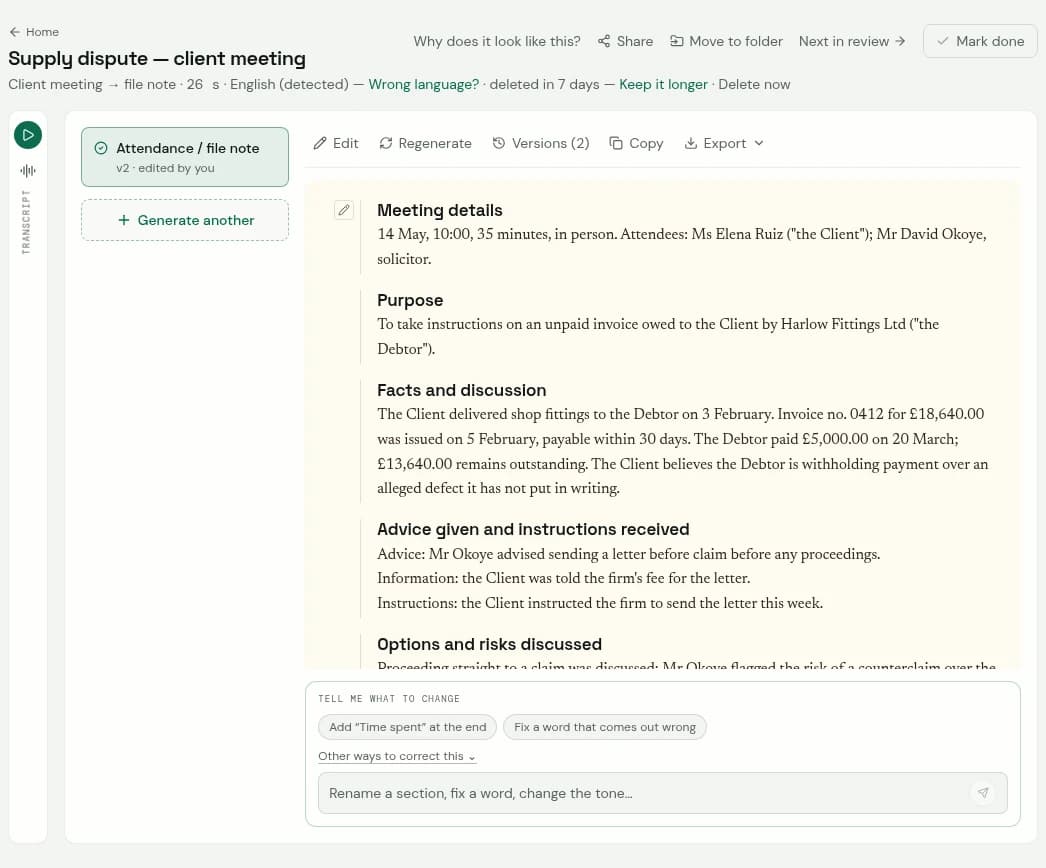
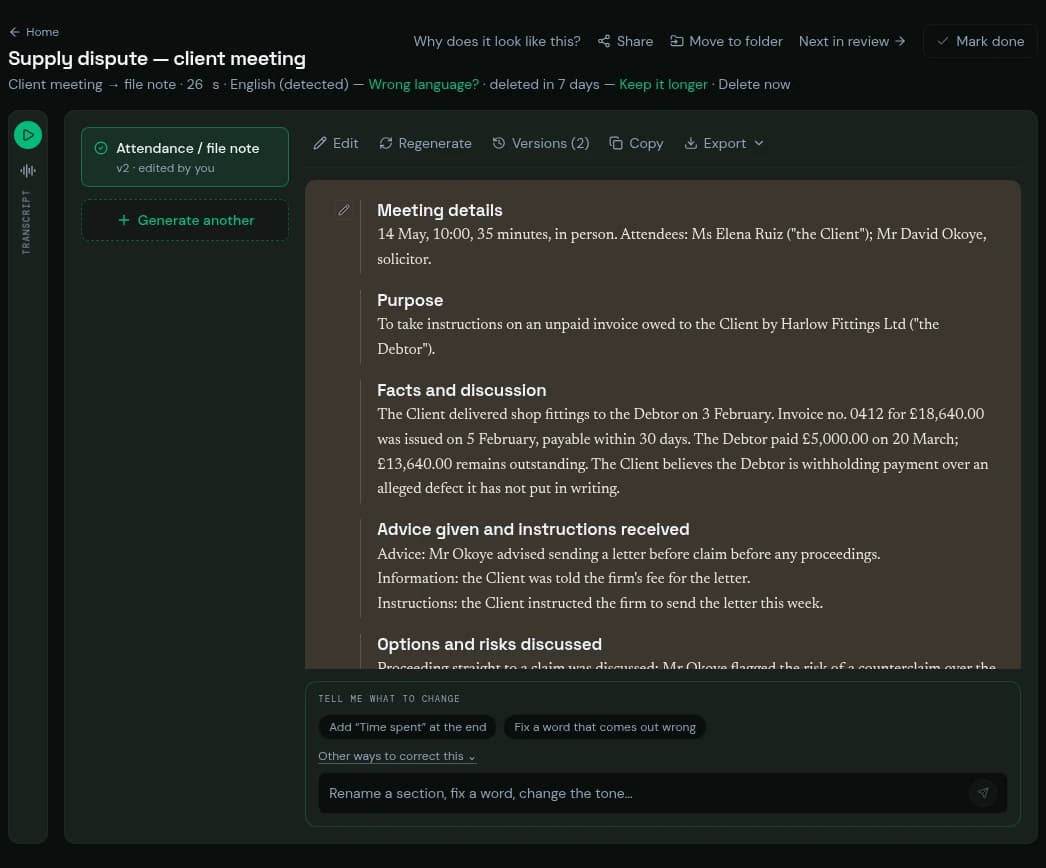
- The transcript, folded beside the document: one press opens it, line by line with times.
- The document, in its sections.
- A change, asked for in your own words.
Verbato's app. The content was written to show it.
- The note and the letter from one meeting: file the recording as a client consultation and it comes back with both, each written from the same transcript.
- A passage checked against what was said: where the note records its source, Hear the source beside a section opens the transcript at that moment and plays the audio from there.
- What comes back: the document, written in the language of the recording, with the word-for-word transcript beside it. A document can contain errors, and it is yours to check before it goes on the file or to a client.
- Your recordings: processed and stored in the United States and Canada, and never used to train or improve AI models. Nobody at Verbato listens to them or reads them, unless you ask us to in order to resolve a support issue, or we are required to.
- What you pay for: hours of audio. Documents, corrections and exports are not counted. The plans are on the pricing page.
Check before you file or send
- The note was written on the day of the meeting; if it was rewritten later or produced with software, it says so, and the lawyer who attended has checked it, as the Queensland guidance asks of a note made with AI.
- Names, dates, amounts and deadlines match the file.
- The client’s account and your advice are kept apart, and nothing appears that nobody said.
- The letter to the client matches the note, in plain language.
- In a dictated letter, every instruction was carried out and none was typed in.