A therapy progress note is the record of one session: what the client reported, what you observed, what you did, how the client responded and what comes next. It lets you pick up the thread next time, lets another clinician follow the work, and shows what you did and why. In the UK it is often called case notes or clinical notes. This guide covers what goes in, SOAP and DAP with an example of each, risk, and the other documents of a course of therapy.
What a progress note is for
A progress note is part of the client’s clinical record, so write it for a reader: a colleague covering your caseload, a supervisor, the client if they ask to see their record, or you a year from now. The American Psychological Association’s record keeping guidelines (2007) are a useful reference, but they are guidance. What you must record, and for how long, is set by your licensing board or professional body, the law where you practice and your employer.
In the US, the federal Privacy Rule for health information sets psychotherapy notes apart: a mental health professional’s notes documenting or analyzing the conversation of a session, kept separate from the rest of the record. The definition excludes session times, the modalities and frequency of treatment, test results, and any summary of diagnosis, functional status, treatment plan, symptoms, prognosis and progress. Those belong in the progress note; half-formed hypotheses and your own reactions to the client do not.
In the UK, the British Association for Counselling and Psychotherapy’s Ethical Framework (2026 edition, in force from 3 November 2026) asks for records that are “factual, adequate and relevant for the type of service offered”, kept under the data protection law of the country where they are stored.
What to include in every note
Whatever the format, a complete progress note records:
- Session details: date, start time and length, format (in person, video or phone) and who attended.
- The focus: what the client brought, or what you agreed to work on.
- What the client reported, in their own words where the wording matters.
- What you observed: affect, speech, behavior, and any measure you gave.
- What you did: the interventions and techniques you used.
- How the client responded.
- Risk, when assessed: what you asked, what the client said, what you did.
- The plan: homework, changes to treatment, referrals and the next appointment.
What to leave out, and how to word the rest
A note is not a transcript: it records what changes the work, not every exchange. The APA guidelines ask for only the information germane to the service, and for care with derogatory or pathologizing language.
- Separate what you heard from what you think. “The client said she has not slept” and “she seemed exhausted” are different statements; show which is which.
- Describe behavior, not labels. “Avoided eye contact and spoke quietly” tells a reader more than “was odd”.
- Quote when the words matter: about harm, a disclosure or a turning point.
- Write it soon. The APA guidelines ask for entries as soon as is practicable after the service.
- Write for an outside reader. No shorthand of your own, no judgments, nothing you would not want the client to read.
The SOAP format
A SOAP note records a session in four parts: Subjective, Objective, Assessment and Plan. It comes from the problem-oriented medical record that Lawrence Weed set out in 1968, and counseling took it up for case notes; Cameron and turtle-song (2002) teach it section by section for counselors.
- Subjective: what the client reports: how they are, what has happened, how the homework went.
- Objective: what you observe: affect, speech, behavior, and any scale or measure.
- Assessment: your clinical reading: progress toward the goals, any change in risk. Interpret the first two sections; do not repeat them.
- Plan: homework, changes to treatment, referrals and the next session.
Illustrative example. Written to show the format: the client, the figures and the quote are invented, and the note was not produced by Verbato.
| Section | Entry |
|---|---|
| Session | Individual session 6, 50 minutes, by video. |
| Subjective | The client reported sleeping about five hours a night and said, “Sunday evenings are the worst.” Completed the activity schedule on three of seven days. Asked about thoughts of self-harm, said she has had none. |
| Objective | Flat affect and slowed speech; brighter when describing two walks. Self-rated mood 4/10 (2/10 at session 5). |
| Assessment | Low mood persists, with early gains in activity. Partial progress toward goal 1. No new risk indicators. |
| Plan | Continue behavioral activation; add one activity with another person. Next session in one week. |
The DAP format
A DAP note folds SOAP’s first two sections into one, for three parts: Data, Assessment and Plan.
- Data: what the client reported and what you observed, each attributed: “the client reported”, “the clinician observed”.
- Assessment: your clinical reading and progress toward the goals.
- Plan: the next steps and the next appointment.
It is quicker to write, and many clinicians use it for routine follow-ups. The risk is that Data blurs what the client said with what you concluded; attribute every statement.
Illustrative example. Written to show the format: the couple, the details and the quote are invented, and the note was not produced by Verbato.
| Section | Entry |
|---|---|
| Session | Couples session 3, 60 minutes, in person. Both partners attended. |
| Data | Partner A reported two arguments about chores this week, both ending with A leaving the room. Partner B said, “It feels like talking to a wall.” In the speaker-listener exercise, B interrupted twice in the first round and not in the second. |
| Assessment | The pursue-withdraw pattern noted at intake appeared when chores came up. Early progress toward the shared goal of finishing a disagreement without leaving the room. |
| Plan | Practice the exercise twice at home on a low-stakes topic. Next session in one week. |
SOAP vs DAP
| Aspect | SOAP | DAP |
|---|---|---|
| Sections | Subjective, Objective, Assessment, Plan | Data, Assessment, Plan |
| The client’s report | Subjective | Data, attributed to the client |
| Your observations | Objective | Data, attributed to you |
| Reading and next steps | Assessment and Plan | Assessment and Plan, the same |
| Strength | Report and observation cannot be confused | Quicker to write and to read |
| Watch for | The same facts repeated in Subjective and Assessment | Report and observation blurring into one |
| Suits | Complex cases, and records several people read | Routine follow-up sessions |
Both work. If your employer, agency or insurer prescribes a format, use it: the APA guidelines note that some settings mandate the record’s format. Otherwise, choose one and keep to it for each client; a record whose notes all follow one order is quicker to read.
Writing about risk
When risk comes up, the note should show what you asked, what the client said, the risk and protective factors you identified and what you agreed. Quote the client’s own words about harm. If you asked and the client denied thoughts of self-harm, write that; if you did not ask, write that risk was not assessed, never that there is none.
A fuller risk assessment, written when risk is raised or rises, records ideation, intent, plan and means each on its own, the factors that raise or lower risk, your judgment of its level and the safety plan agreed. Your service’s risk policy sets its form.
The other documents in a course of therapy
Intake assessment
Written after the first session or sessions, it is the base for what follows: the presenting problem and its history, relevant personal, family and medical history, social context, a mental status examination, risk, strengths and supports, a diagnostic impression where your role calls for one, and initial goals. Mark what was not covered, so a gap is not read as “nothing to report”.
Treatment plan
Turns the assessment into a route: the problems to work on, goals you can tell are met, measurable objectives for each, the interventions you intend, how often you will meet and when you will review the plan. A plan never reviewed stops describing the real treatment.
Case formulation: the 4 Ps
Explains why this client has this difficulty now, and so guides what you do. The four Ps sort the factors: predisposing (what made the client vulnerable), precipitating (what set the problem off), perpetuating (what keeps it going) and protective (what helps). Macneil and colleagues, in BMC Medicine (2012), add the presenting problem as a fifth P and argue that a diagnosis alone says little about causes or about which intervention to choose. Date the formulation and revise it as new information emerges.
Recording the session or dictating afterwards
Two ways to avoid starting the note from a blank page:
- Record the session. You keep the full record of what was said. First, the client gives informed consent, knowing what is recorded, why, who can access it and how long it is kept. The recording and any transcript become part of the record: BACP’s 2026 framework counts all communications, notes and other information held about a client.
- Dictate a recap once the client has left: what the client reported, what you observed, what you did and what comes next. The client is not recorded, and you order your reading while it is fresh.
If you use an AI or other digital tool for either, BACP’s 2026 framework asks you to assess its risks first, understand how it handles data, be open with clients about it, have their informed consent before putting their personal data into it, and stay responsible for evaluating what it produces. Whatever your professional body, the finished note is yours to check and sign.
Writing your notes with Verbato
Verbato writes therapy documents from a recorded session or the recap you dictate afterwards: the SOAP progress note, the DAP progress note, the intake assessment, the treatment plan, the 4 Ps case formulation and the risk assessment note.
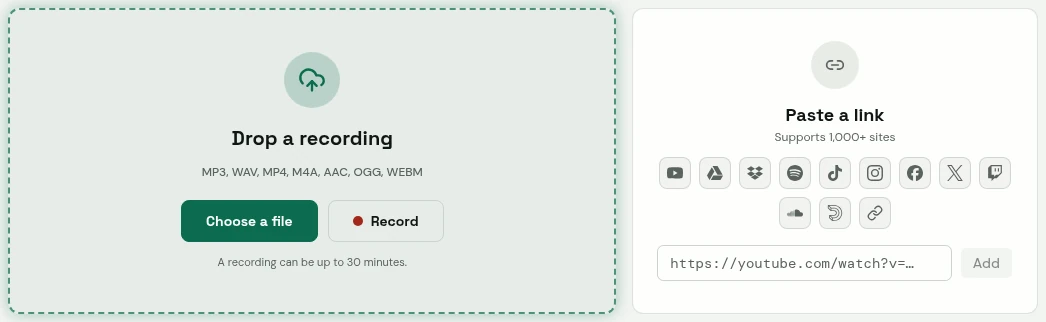
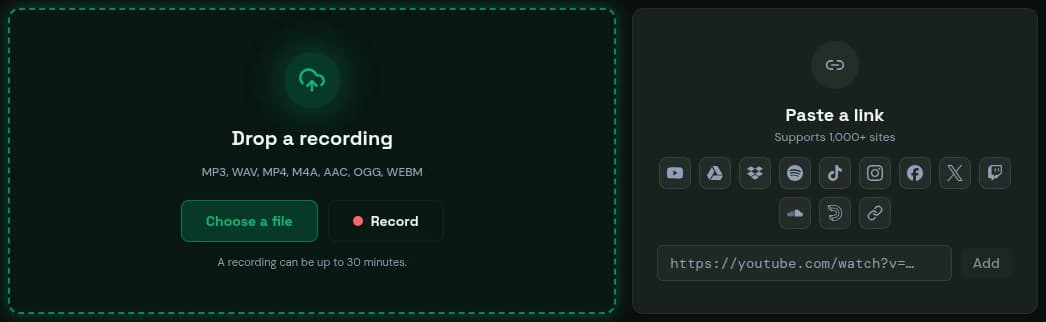
- Drop a file, or record in your browser.
- Or paste a link.
Verbato's app. The content was written to show it.
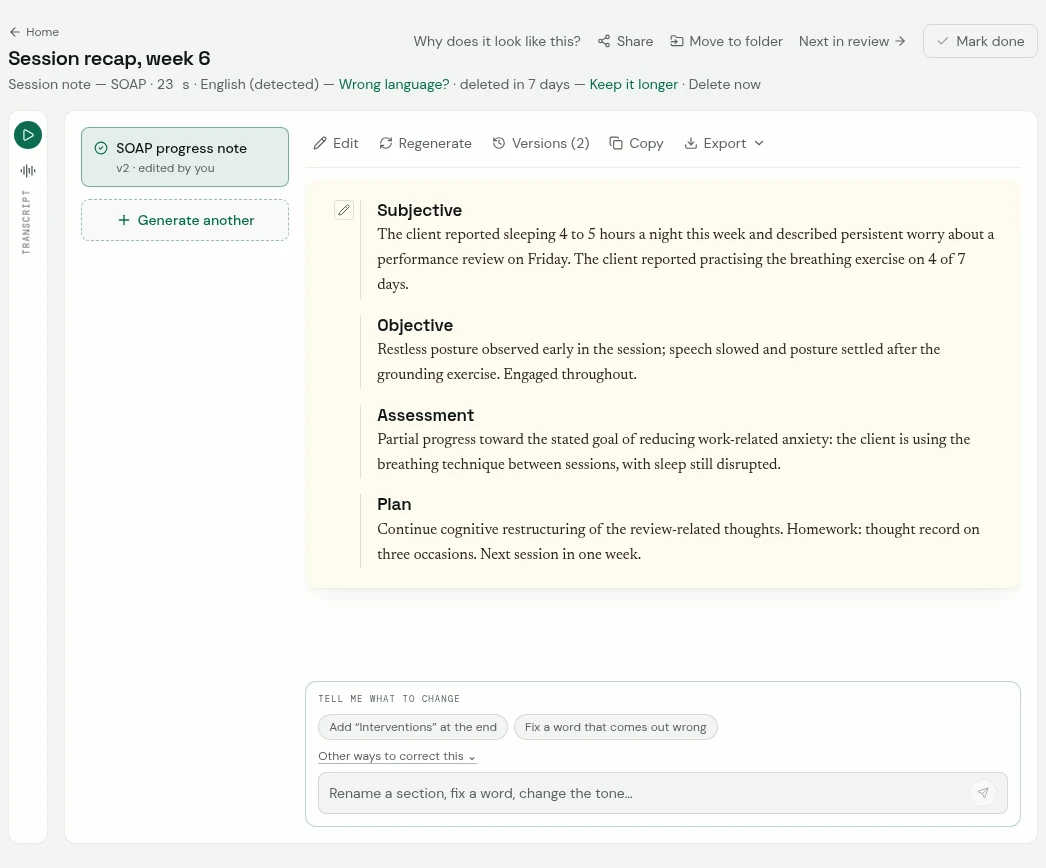
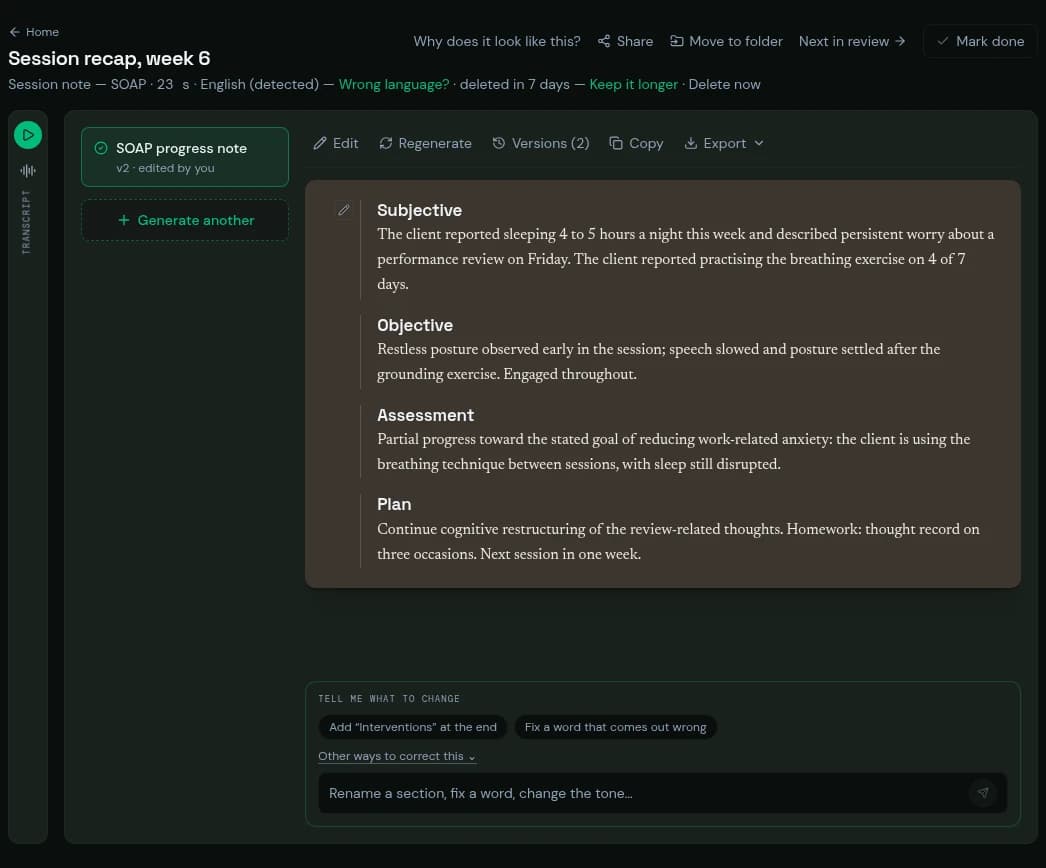
- The transcript, folded beside the document: one press opens it, line by line with times.
- The document, in its sections.
- A change, asked for in your own words.
Verbato's app. The content was written to show it.
- SOAP for some clients, DAP for others: each recording is filed under its kind, and each kind writes its own note.
- A section you do not use: switch it off and it is left out of the next note, without being deleted. On a pack’s note, Verbato first makes it a note of your own.
- What comes back: the note, written in the language of the recording, with the word-for-word transcript beside it so you can see what was said. A document can contain errors, and it is yours to check before it goes into the record.
- Your recordings: processed and stored in the United States and Canada, and never used to train or improve models. Nobody at Verbato listens to them or reads them, unless you ask us to in order to resolve a support issue, or we are required to. What Verbato does and does not do with sensitive recordings is on a page of its own.
- What you pay for: hours of audio. Documents, corrections and exports are not counted. The plans are on the pricing page.
A checklist before you file
- What the client said and what you concluded are clearly apart.
- The date, length and format match the session.
- If risk came up: what was asked, what was answered, what was done.
- The plan says what happens next, and when.
- Nothing in the note that did not happen in the session: no filler, no conclusion you did not reach.