A veterinary SOAP note is the record of one consult. It is what a colleague reads when the animal comes in on their shift, what you need when the case returns months later, and what shows what was examined, recommended and decided. This guide covers each section, how to write doses nobody can misread, and the three documents that most often follow a consult: the client take-home summary, the recheck note and the referral letter.
What the record has to hold
In the UK, the RCVS guidance on clinical and client records asks for clear, accurate and adequately detailed records, made at the time or as soon as reasonably practicable, that support continuity of care: examinations, treatments, test results, plans for investigation, who provided the care and the advice given to the client. A correction should be dated, show who made it, and not remove or obscure the original entry.
In the US, the rules are your state board’s. The AAVSB, the association of those boards, published model regulations on medical recordkeeping in 2025. The record they describe holds, among other items, the differentials, each medication’s name, strength, dose, route, frequency, quantity and duration, informed consent, a summary of communication with the client, any recommendation the client declined, and discharge instructions. They also ask the record to say when artificial intelligence was used to create or update it, and leave the final record’s accuracy with the licensee. Check what your own state has adopted.
Start with the signalment
- The patient: name, species, breed, age, sex and neuter status, and microchip number if there is one.
- Today’s weight, every visit. It is the base of every dose and a finding in itself. If your scale reads pounds, record the kilograms you dosed from: a mg/kg dose worked out on the pound figure is 2.2 times too high.
- The client, how to reach them, and anyone else authorized to decide for the animal.
- The date, the reason for the visit and who saw the patient.
The SOAP format
SOAP stands for Subjective, Objective, Assessment and Plan. It grew out of the problem-oriented medical record that Lawrence Weed described in 1968, built around a numbered list of the patient’s problems, and it follows the consult: you listen, you examine, you think, you decide.
Subjective: what the owner tells you
- the presenting complaint: when it started, how it has changed, what makes it better or worse;
- appetite, thirst, urination and defecation, vomiting or diarrhea, coughing, energy;
- current medication, including parasite control and supplements, and vaccination status;
- the environment: indoors or outdoors, other animals at home, recent travel or boarding.
You did not measure any of this, so write it as reported: “Owner reports two episodes of vomiting since Monday.” Quote the owner when the exact words matter.
Ask about diet with care. In 98 recorded appointments in Ontario, vets most often opened with one question about what the animal eats; owners usually named a single food, often only its brand, and later questions mostly clarified that food (MacMartin et al., 2015). Ask about everything it eats in a day, treats, chews and table food included.
Objective: what you examine and measure
- Vital signs: temperature with its unit, °C or °F, heart and respiratory rates, mucous membranes, capillary refill time, hydration, body condition score, and a pain score if you use one.
- The exam by body system, with what you found in each.
- In-house results, with their units.
Write what you found, without interpretation, and write “normal” only for what you examined. If you did not auscultate the chest, the note cannot call it normal: “not assessed, patient tense” is the true line, and it tells the next vet what is still to check. Record the exam before vaccines in full too: it is the baseline for the next sick visit.
It helps to say findings aloud as you go: “her gums are pink, she flinches when I press on her belly.” The owner follows the exam, and if you record the consult, the Objective section is on the recording as you said it, not rebuilt from memory that evening. Ask the owner before you record, and say what the recording is for.
Assessment: your reading of the case
A numbered problem list, even when the visit was for something else: a dog in for vaccines may also have an ear infection and a few extra kilos. For each problem, the differentials in order of likelihood and the working diagnosis if you have one, hedged as you would say it: “most likely”, “not excluded”. Add the prognosis when you discussed it with the owner.
Plan: what happens next, problem by problem
Each problem gets its own plan, by its number, so the ear recheck finds what was decided for the ear at once.
- Diagnostics: what you ran, what you offered and what the owner declined.
- Treatment: the drug and its concentration, the dose in mg/kg and the total dose, so anyone can check the arithmetic, the volume, the route, how often, for how long, and what was dispensed.
- Client communication and consent: the options discussed, the estimate and what the owner agreed to. The RCVS guidance on communication and consent ties informed consent to reasonable options, their fee estimates and their main risks, and asks for limited or withheld consent to be recorded.
- Follow-up: when to recheck, and what should bring the owner back sooner.
Write doses nobody can misread
A dose is read by the nurse who draws it up, the colleague who refills it and the owner who gives it. The ISMP list of error-prone abbreviations and dose designations comes from human medicine, but its misreadings can happen on any chart:
- A leading zero, never a trailing one: 0.5 mg, not .5 mg, which can be read as 5 mg; 1 mg, not 1.0 mg, which can be read as 10 mg.
- Units written out: “units”, not U, which has been read as a 0 or a 4; mcg, not µg; mL, not cc.
- Sides written out: AD and AS, right and left ear, have been mistaken for OD and OS, right and left eye.
- Full drug names, with a space between the name and the dose.
An example
Illustrative example, written to show the format. The patient, the owner and every figure are invented. It was not produced by Verbato.
- Signalment: Biscuit, canine, Beagle, 7 y, FS, 15 kg today. Lame on the right hind leg for 3 days.
- Subjective: Owner reports lameness since an off-leash run on Saturday; worse after rest. Eating and drinking normally. No current medication.
- Objective: BAR. T 38.6 °C, HR 96, RR 24. Mucous membranes pink, CRT under 2 s. BCS 6/9. Weight-bearing lameness, right hind. Pain on extension of the right stifle, mild effusion. Cranial drawer not assessed: patient tense. Left hind and forelimbs: no pain on manipulation. Chest auscultated, abdomen palpated: no abnormalities.
- Assessment: 1. Right stifle pain and effusion: cranial cruciate ligament disease most likely; meniscal injury not excluded. 2. Overweight.
- Plan: 1. Sedated exam and stifle radiographs offered, with estimate; owner declined today. Meloxicam oral suspension 1.5 mg/mL: 0.2 mg/kg (3 mg, 2 mL) PO in clinic today, then 0.1 mg/kg (1.5 mg, 1 mL) PO once daily with food for 6 days; 10 mL dispensed. Leash walks only. Owner to stop meloxicam and call if vomiting, diarrhea, black stools or not eating. Recheck in 7 days. 2. Weight plan at recheck.
The client take-home summary
A worried owner forgets much of what is said in the room, and how clearly the plan is put matters. In 83 recorded consultations in Ontario, the odds that a client followed a recommendation for dental or surgical care were seven times as high when the recommendation was clear as when it was ambiguous (Kanji et al., 2012). A good take-home summary:
- Says what is wrong in everyday words, explaining any term it cannot avoid, as the RCVS guidance asks.
- Turns every medication into a full sentence: how much, how, when, with or without food, until when.
- Lists the signs that should bring the animal back early, and the date of the recheck.
- Says what the plan says. If the record and the summary disagree, the owner will follow the summary.
The example’s instruction, in each register:
- In the record: Meloxicam 1.5 mg/mL, 0.1 mg/kg (1.5 mg, 1 mL) PO once daily with food for 6 days.
- In the summary: Give Biscuit 1 mL of meloxicam liquid by mouth once a day, with her food, for the next 6 days. Today’s dose was given at the clinic.
The recheck note
A recheck continues the last consult, and the note should let the two be compared.
- The problem being rechecked, named as in the first note.
- The interval history, as the owner reports it, including missed doses and trouble giving the treatment.
- Today’s findings against the last visit’s: the weight, the lesion, the results.
- Your read of the response: improved, unchanged or worse. If you did not assess it, do not infer it from the findings.
- The plan: continue, adjust, or close the problem.
The referral letter
The specialist who reads it has little time and none of your context.
- The question, first: what you want the specialist to assess or do.
- The signalment and the case so far: the presentation, the course and what has been ruled out.
- Tests and results, with values, units and dates, the reports attached and imaging in its original format where the receiving clinic can read it.
- Treatment so far and the response, including what failed.
- The urgency, if there is any, and how to reach you.
Writing your notes with Verbato
Verbato writes veterinary documents from what you record or dictate: the SOAP note, the client take-home summary, the recheck note and the referral letter.
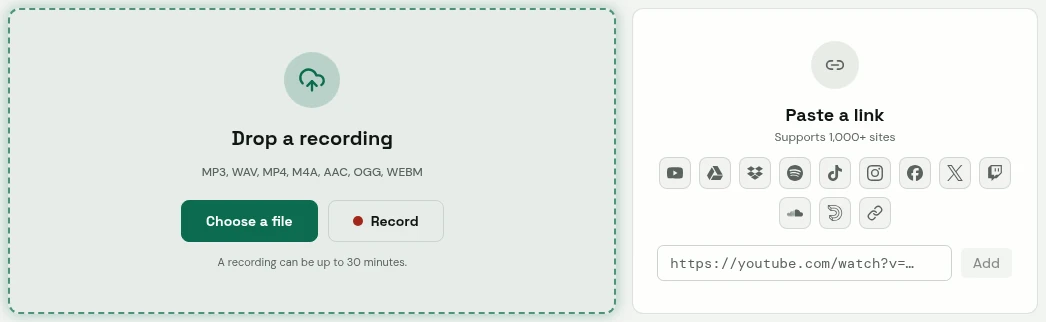
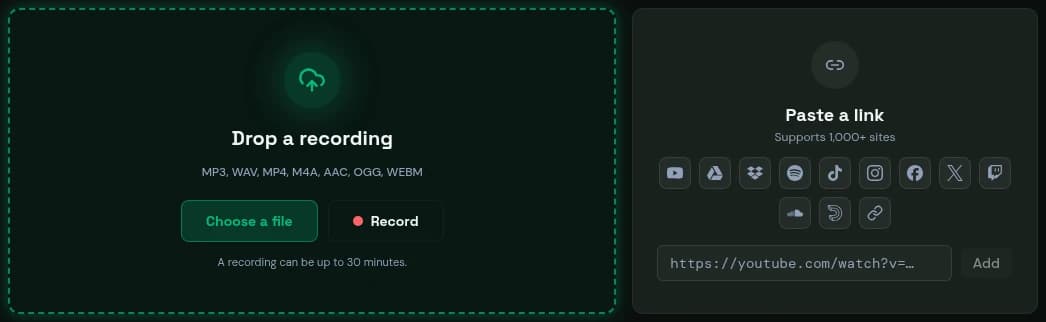
- Drop a file, or record in your browser.
- Or paste a link.
Verbato's app. The content was written to show it.
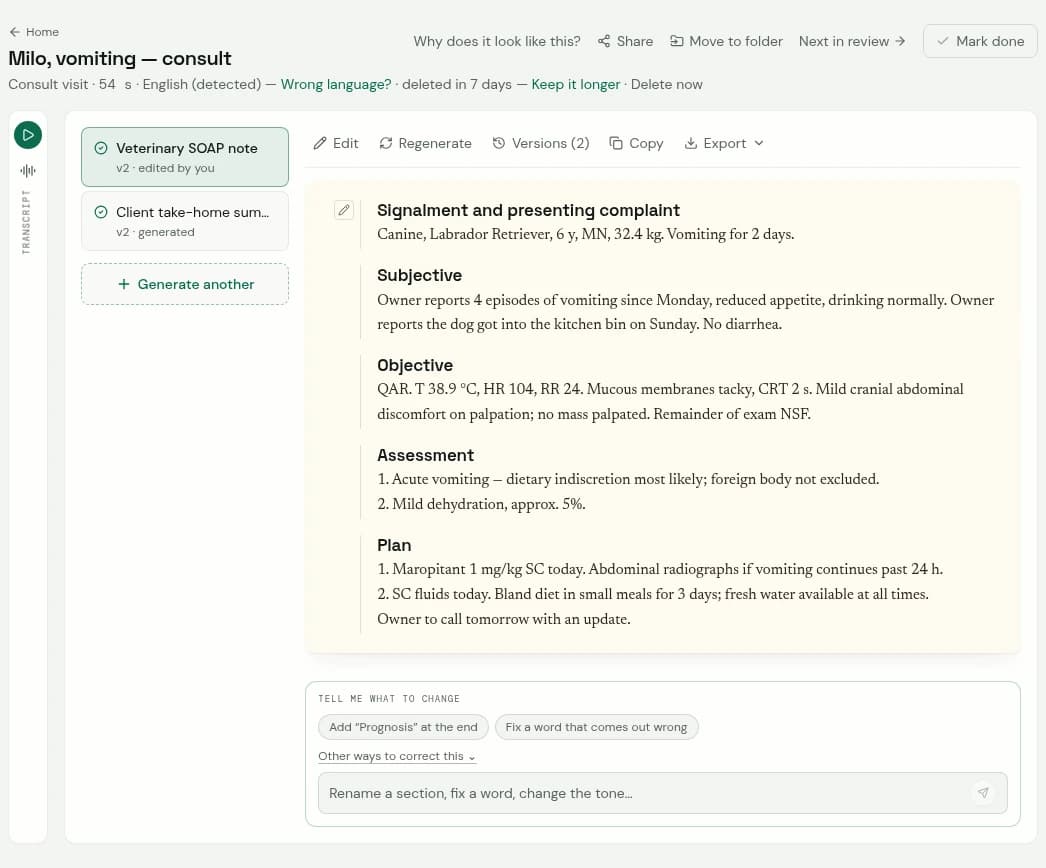
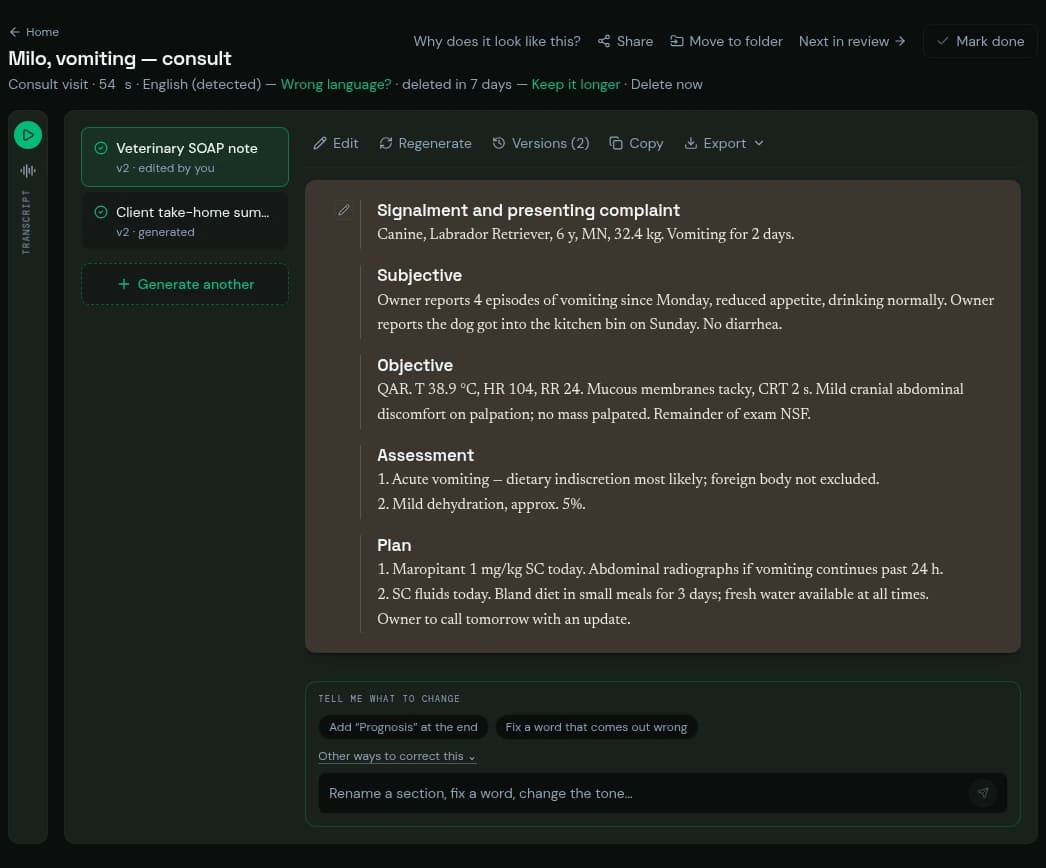
- The transcript, folded beside the document: one press opens it, line by line with times.
- The document, in its sections.
- A change, asked for in your own words.
Verbato's app. The content was written to show it.
- The SOAP note and the take-home summary from one consult: install the Veterinary pack, free on any plan, file the recording as a consult visit, and both come back, each written from the same transcript.
- The referral letter when you need it: written from your dictation, or later from the consult’s transcript, which uses no hours.
- What comes back: the documents, in the language of the recording, with the word-for-word transcript beside them so you can see what was said. A document can contain errors, and it is yours to check before it goes into the record or home with the owner. Each exports as Word or PDF.
- Your recordings: processed and stored in the United States and Canada, and never used to train or improve models. Nobody at Verbato listens to them or reads them, unless you ask us to in order to resolve a support issue, or we are required to.
- What you pay for: hours of audio. Documents, corrections and exports are not counted. The plans are on the pricing page.
Before you sign
- Each total dose matches today’s weight in kilograms and the mg/kg dose; mg/kg is not mg, and mL is not mg.
- The take-home summary names the product the owner takes home, at the strength dispensed, and says what the plan says.
- Sides are right: left and right, ear and eye, fore and hind.
- No “no” has gone missing: a lost negation reverses a finding.
- “Normal” appears only where you examined.
- What the owner agreed to, and what they declined, is in the record.
- If an AI tool helped write the record and your board asks for it, the record says so.